The Right Stories

Let's talk about (5)

We like a good story.

No, not just me (which could very well be the case in some situations for this former English teacher). We all do. Stories drive us to do more, want more, and achieve more. They’re how we relax, how we inspire, and often, they’re how we find our place.

Sometimes, though, I worry we buy in to some stories that aren’t true as educators. They sound true, and if we’re not careful, we’ll use them as excuses or they can even become ways we beat ourselves up about our performance (or seeming lack thereof). Within each of them, I think there’s a kernel of truth, but when that warps into fiction, it has the power to bring guilt and shame onto us.

This semester, I’ve been reassured of this power held within stories; unfortunately, that reassurance has been brought to light as I’ve caught myself believing three particular stories about myself as an educator.

Like many educators this year, I’ve put plans in place that have failed, I’ve made missteps with students and teachers, and I’ve had to ask for help. Not all the time. Not even each week. But more than I’d like.

Like you’d assume, this has not been really fun for me.

I like to have things together for myself (because I’ve told myself I can help others better if I’m together–or if I can at least make it look like I’m together–I’ll leave that for another post though). But with each step, I’ve come closer to telling myself a story that’s true. One that’s a more accurate reflection of where I’m growing and where I need to grow.

I’m hopeful you’re able to recognize those places in you, and I’m hopeful that we can walk along the path toward growth together.

THE “I CAN MAKE EVERY STUDENT SUCCESSFUL” STORY

Investing in each student’s success is a great way to spend our time and effort. Even with good intentions, we could do far, far worse. Still, I think we sometimes fall into the trap of taking the blame when students choose to walk away from our best efforts.

Do I believe that great educators put every opportunity in place for students to be successful? Yes. Do I believe that great educators are invested in the relationships they maintain with their students? Yes. Do I believe that too often, educators take is too personally when students don’t take every opportunity that’s put in front of them? Yes.

I think you’d be hard pressed to find great educators who are satisfied with just helping most (but not all) of the students in their classes, but I do think that at times, educators begin to think that they can make every student be successful. This isn’t limited to academic success either.

THE “GOOD EDUCATORS MAKE THEIR STUDENTS BEHAVE” STORY

I also think that great educators inadvertently begin to believe that with the right experience, the educators who have this down (you know, those who have arrived, those who are pros at this) can make their students to behave.

Great educators certainly have more than a basic handle on classroom management. Their skills are extensive, they’re not easily rattled, they never escalate with students, and they can deescalate students with ease.

Still, their best laid plans can and do fail.

When they do, my worry is that others in the building start to look at a educator’s interactions with a student (nearly always a situation where the onlooker does not know what’s led up to that moment) and make a judgment on the educator based on the student’s behavior. I also worry that educators in this situation start to feel like a failure because he or she can’t make change happen as fast or to as great an extent as preferred.

I don’t believe that it’s the educator’s responsibility to make his or her students behave. You just can’t force them to if they’re bent on not doing it.

Here’s what I do believe: it’s a educator’s job to teach expectations for student behavior and reteach in response to gaps in student achievement. I see great educators putting innovative plans in place all the time to do everything they can do draw students toward the best choice. But even the best plans can’t make students comply (if they do force compliance, then while you feel you’ve won the short game, you’ve only demanded compliance; no transformation has happened). As much as we want it for our students, students have the great privilege and responsibility of stepping in the right direction with any given choice.

Still, at times, all of our tricks seem to fail, and we’re left wondering what to do now that we’ve tried everything.

THE “GREAT EDUCATORS DON’T NEED ANY HELP” STORY

When the plans we put in place don’t work, educators need to know when to call in extra support.

We tend to value those who are self sufficient and those who seem to not need the help of others. I don’t think this is unique to education, but somehow, despite what we know about the value of creativity and the help that is derived from connecting, collaborating, and interacting with others, the person who doesn’t seem to need any help often seems to be the one who is doing it right.

But teaching is messier than that. We need help to work through the toughest parts of the job (especially those that deal with the complexities of relationships). After all, we are pretty complicated.

I can’t think of a stage of an educator’s career where this gets easy. A new teacher wants to get in and prove he can do this job. A teacher with a few year’s experience wants to show he’s learned from the missteps of the past few years. Teachers with more experience might wonder how others would react to an experienced teacher who can’t handle a particular situation. And teachers who are already in coaching roles, no matter the level of formality involved, are the ones who are supposed to have figured this out, right?

Here, my worry is that in an effort to save face, we miss opportunities to serve each other and grow together as professionals.

The reality is that we don’t often love talking through mistakes and shortcomings, but we end up growing through that process in marked and impactful ways. Ways that tie directly to improving our work with students. Ways that make deep impact on the already fantastic work that educators are constantly invested in.

SO, HOW DO WE WRITE THE RIGHT STORY?

With so many potholes in the streets we’re traveling, I’d like to end with a few suggestions about how to make quick changes to make sure you are telling yourself the right story.

First, I think we have to acknowledge that recognizing that we need growth is not a flashing red light that should alert others that something is wrong. Recognizing our weak spots should be part of our professional process of improvement, but that’s easier said than done.

I’ve seen teachers use a “favorite no” or a “favorite mistake” as a point of departure for helping students overcome common mistakes. (Here’s a great video on the topic.) I wonder what the impact would be if we had a teacher version of this practice. What questions would it open up? What common ground would people establish? What solutions could come from those collaborative conversations?

I think finding unity in those things that we collectively need growth in could make a huge impact on developing a culture where risks are embraced and where a community of professionals can try on new ideas in a safe environment.

Where risk is welcomed and vulnerability is embraces, the right story writes itself.


One quick caveat: I’ve presented this as an antidote of sorts for the educators who work hard to serve students well but might still be overly critical of themselves or others. The concessions I’m offering in response to the worries mentioned here are not at all licence to do things half way or give up before doing your very best for the students you serve.

Set Students Up For Failure?

I’m fascinated by our opportunity to teach our students about failure, its impact, and their ability to overcome their own failures. I know I would have benefited from this instruction as a high school student, so it’s often on my mind as I work through each week on campus.

I’m always looking for something that can help facilitate that conversation about failure well, and it was in pursuit of some new inspiration that I stumbled up on this video recently by a few graduate students at Harvard. I was fascinated by it. It’s pushed me to reconsider a number of assumptions I made (or wonder if I made), and in the best way possible, it’s left me with a few ideas I can’t shake.

There’s a lot there in this video, but more than anything, I’m stuck replaying this line from professor Heather Hill. When talking about the role that risk and failure play in our learning, she comments that, “Teachers who are crafty start to design instruction that kind of responds to that [the impending stumble] ahead of time and highlights it and brings it up, so that kids will make that mistake; it’s called provoking the stumble.”

PROVOKING THE STUMBLE

That phrase, “provoking the stumble,” I love that.

But here’s where I’m stuck: how do we balance the idea of provoking stumbles with the idea of individualizing to help students be successful? Outside of a “you have to know your students” answer, how do we give guidance to those teachers who do know their students well and still struggle to answer this question well?

The way I see it, if we know that students benefit from overcoming challenges, we know that grit is developed in that zone of just right stretch, how can we not begin to invest ourselves in provoking stumbles for our students?

If we’re going to go down this road (and I do think we need to start down this road–or maybe start blazing a new trail in this direction), we have to be prepared with more than a shoot from the him response to parents who, understandably, will question why we are doing this. From one vantage point over a shortened time frame, we are setting students up for failure. But given a longer view, we’re preparing students to know that they can recuperate from failure and overcome adversity.

WE NEED TO FIRST BE LIMITED IN ORDER TO BECOME LIMITLESS

Part of overcoming our struggles (I won’t put all this on you, but I imagine some will identify with this) my struggles is a healthy, painful realization that I can’t do everything I would like. This isn’t an exclusively academic or professional realization by any means. I wish I could run like I could when I ran cross country in high school. I wish I could stay up (to write this blog, even) late at night without feeling it the next day (or two or three). The reality is that I have limits.

New ones seem to show up each day.

I came across Phil Hansen’s TED talk around the same time I say the “What Makes Good Teaching?” short, and I think Hansen is leading me toward my answer. You see, Hansen is an artist who (spoiler alert) can’t draw a straight line.

Given the choice to simply give up on being an artist, he chooses to overcome a considerable limitation and “Embrace the Shake” so that he can continue to develop his creativity and pursue his calling as an artist. That’s all I’ll summarize; take a few minutes to take in his message here:

WHAT NEXT?

I need your help. How do you balance this dichotomy: helping students experience success v. helping students learn to overcome failure? I’d love to hear examples of how you balance both well. The ways that you “set your students up for failure” (which, when done in this spirit, of course, is setting them up for long term success) will help me help teachers, and they will help me think through the parallels for professional development in our school and district.

Please do share. I truly appreciate any feedback you have. Together, we can come up with some great ways to challenge and support students through failure toward success!

5 Positive Hallway Conversations

dreams don't workunless you doI spend a lot of time in our hallways.

At the very least, I’m there before school, during every passing period, in the cafeteria at lunch, and at parent pickup after school. (Ok, I’m expanding to include some of our common areas, but work with me here.) Part of my job in each of those locations is to look for any issues–times where students aren’t meeting campus expectations–but while this is important, it’s not exactly the sort of life giving work that I wanted to do when I grew up.

Over time, I began to wonder how I could use this time differently. I needed to accomplish the initial goal, but I wondered if I could repurpose or reframe my time in the hallways to make it more than just enforcing expectations.

Going into this year, I wanted to find ways to make my interactions more positive with students. I’m one who believes there’s great value in initiating positive interactions with students, and it always frustrated me when I felt like all I did during a passing period was remind students to be on time, wear their IDs, and enforce the dress code.

So I set out to try something different. I’ve been trying these ideas out over the past week. Some are easier fits than others for the first week, but I’ve tried each. Because so many educators have time assigned to be in visible in the hallways, I want to share them (and I want to know what you’d add to the list). Here are five things I’ve tried.

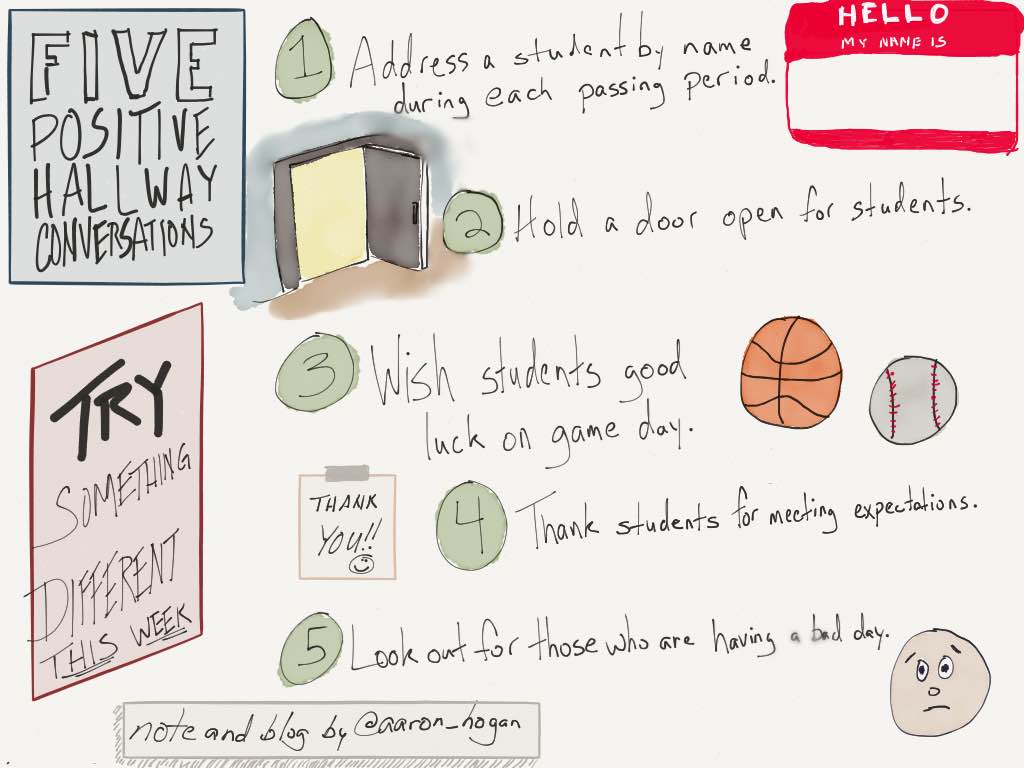
FIVE WAYS TO INITIATE POSITIVE CONVERSATIONS

1) Address a student by name during each passing period. I’m not great with names. Right now, I know a lot of names, I know even more faces, and they’re slowly matching back up; still, the process is slow for me. This active step helps me constantly push the number of student names I can easily recall up. If you see someone you know, ask him or her how the day is going. If you don’t see anyone you know, learn a name. Students often walk the same routes. Get to to know them as they move past your location in the building.

2) Hold a door open for students. This afternoon, I held the door open for students as they left toward our parent pickup area. It created a natural conversation space for me to interact with students, and some positive conversation came out of it that wouldn’t have otherwise. As an administrator, the perception can grow among students that my job is to correct mistakes. Of course addressing students who are not meeting campus expectations is part of my job, but it’s far from the entire (or even the majority) of what I do. Holding open the door puts me in a place of service to students. I like that.

3) If you’re on a campus with athletics programs, wish students good luck at their events on game day. We have close to 500 freshmen on campus, and seeing the volleyball, football, and cross country athletes in their respective gear has already helped me learn several names during time in the hallways. By no means am I saying reduce students to their involvement in extracurriculars, but I’m far from the first to know it’s a great foot in the door to get conversation going with students.

4) Thank students for meeting expectations. This seems odd when I mention it to some people, but I’m a big believer in taking time to provide positive reinforcement for our students who choose to meet our expectations (and yes, this includes everyone from the ones who often struggle to those who could teach the expectations to others). In a seven period day, students could encounter nine sets of expectations (one for each class, one for the cafeteria, and one for the hallways; I’m sure I could list more…). Getting this right is no happy accident, and rewarding students with a bit of acknowledgement shows that we are noticing their work do do things the right way. I think that matters.

5) Ask a consistent question and notice when you get an irregular response. For me this revolves around student IDs. Our students are expected to wear their school IDs when on campus (much to the chagrin of some), but everyone forgets daily expectations from time to time. I regularly ask the same basic question–“Sir/ma’am, do you mind putting on your ID for me?” No, it’s not the most direct way to communicate the “put your ID on” message. Yes, they can say, “No,” in response, but I’m good with that. It’s actually that way by design. You see, what students see as a simple question about a campus expectation I use for much more. I’m constantly looking for students who might not react appropriately so that I can intervene and figure out what’s going on. Maybe life got turned upside down since school ended the day before. Maybe something’s going on between this student and another. Maybe the student missed breakfast for one reason or another. Asking a consistent question helps me intervene when bigger issues may be at play. It has a fringe benefit of identifying students who might need some coaching as to how to address adults well (which happens if I consistently get less than ideal responses to my question). Either way, it’s informing my next steps, which I like.

What other ideas do you have for engaging in positive interactions with students? Share them in the comments or get in touch with me on Twitter (find me here). Hope your time in the hallways is well spent!

5 Positive Hallway Conversations

Teach. And Teach Well.

Kyle Lake, the late former pastor at a church in Waco, TX, passed away suddenly in 2005, and what follows is the conclusion to the last sermon he prepared. It’s one of the most hopeful texts I’ve ever come across, and, at least for me this week, it’s been an antidote of sorts to the situations I cannot control. Here’s what he said:

“Live. And Live Well.

BREATHE. Breathe in and Breathe deeply.

Be PRESENT. Do not be past. Do not be future. Be now.

On a crystal clear, breezy 70 degree day, roll down the windows and FEEL the wind against your skin. Feel the warmth of the sun.

If you run, then allow those first few breaths on a cool Autumn day to FREEZE your lungs and do not just be alarmed, be ALIVE.

Get knee-deep in a novel and LOSE track of time.

If you bike, pedal HARDER and if you crash then crash well.

Feel the SATISFACTION of a job well done-a paper well-written, a project thoroughly completed, a play well-performed.

If you must wipe the snot from your 3-year old’s nose, don’t be disgusted if the Kleenex didn’t catch it all because soon he’ll be wiping his own.

If you’ve recently experienced loss, then GRIEVE. And Grieve well.

At the table with friends and family, LAUGH.

If you’re eating and laughing at the same time, then might as well laugh until you puke.

And if you eat, then SMELL.

The aromas are not impediments to your day. Steak on the grill, coffee beans freshly ground, cookies in the oven.

And TASTE.

Taste every ounce of flavor.

Taste every ounce of friendship.

Taste every ounce of Life.

Because-it-is-most-definitely-a-Gift.”

I think that’s great, and I considered just posting that. But as I read and reread it, I couldn’t help but think that I had something to say to teachers. You see I miss the classroom. A lot. I love my job now, but (like most people who’ve worked two jobs they like) I’d love the chance to take the best parts of each and do that each day. You, too? Right.TEACHSo, I decided to write this (relying heavily on Lake’s text as a model) for teachers.
Teach. And Teach Well.

On the first day of school, try something you’ve never tried before.

Take a RISK. Take a CHANCE. Do something that will stretch you.

Do something crazy. Grade differently. Don’t grade at all. Ask the students what they want to learn. Try out that idea you’ve always wanted to explore—yes, I mean the one you’re not sure will work.

Share those ideas you think are ordinary. They’ll inspire others more than you know.

Give kids a second chance—not just on the first day, but over and over. They’re going to fail (and so are you, and so will I, and it’s ok). And when they fail, let them fail, but teach them that failure is part of their learning and part of your learning. It’s part of mine.

If your students have never experienced success, make their first steps easy.

If your students have experienced nothing but success, push them til they fall on their faces. Their education is incomplete without a chance to learn they can get back up after pushing past their current limits.

In everything you are doing, make the human choice.

Choose to care for a student who is in a tough situation. Choose to help that student be a reader. Choose to help the student who others think doesn’t deserve another chance, another shot, another bit of grace. Choose to ask the tough question, to speak that comment you could pass over, to see the best in others, to extend the benefit of the doubt.

And take care of yourself. You’re teaching students about how hard it is to balance meaningful work with meaningful relationships in a world where 24 hours just don’t seem enough and a time turner seems like a necessity.

Teachers—your job is the hardest job I know of. Your desire to do this the right way and your passion for the young people who walk our halls color our school with contagious optimism.

I’m inspired by your dedication and honored to serve students alongside you.

Thank you for all you do. It is most definitely a gift.

Teachers, I hope you have a wonderful year!

You Are Enough

Before I started teaching, I heard a lot about what to expect during the first year. But other than the (much maligned) “Don’t smile til Christmas” warning (that even as a baby teacher I knew was garbage), I didn’t hear much about the first day.

My eighth first day will be here in another month, and I’d love there to be some stories out there for new teachers to see about something that I’ve heard many educators commiserate about since I started.

My first day of teaching

My first day was terrible. Not in the “I’m supposed to say I was bad because I can tell I’ve grown since then and I don’t want to boast” sense either. It was bad.

I had first period off (which is great any other day of the year for this non morning person), but on the first day it just left time for the knots in my stomach to tie themselves into more dense knots.

Our numbers were growing, so we had portables set up for the first time outside. I was teaching in one, but I didn’t know anything different. I was just happy to have secured gainful employment in July. I would have taught anywhere.

I can remember it like it was yesterday: As I was walking back into the main building to get some water, the power went out. I was going to get a day reprieve! We couldn’t have school with the power out, right? Wrong.

My department head walked around the corner, and instead of telling me she would see me the next day, she said that they were working on getting everything fixed up as quickly as possible.

Awesome.

So I go back to my portable and begin to put on this ridiculous costume that I’m going to use on my first minutes of teaching ever. On top of my uncomfortable shirt and tie teacher clothes I put on a rain jacket. On top of that, I’m wearing my graduation robe. The plan was for me to start with the end (graduation) in mind, then point to how I was going to be their guide on the path toward that goal, and then end with the realization that I was the teacher who could get them there.

What actually happened was more like this.

I put everything on and begin to sweat. Blame it on the first day of school or on it being MY first day of school or on not having any power on August 25th in central Texas. Whatever is at fault, I’m really sweating by the time. Like beads of sweat I can feel. Not fun and not exactly how I wanted to start the day or my career.

I’ll spare you the details about the rest of the day and offer this summary: I pushed through the entire morning of classes packed with 30 high school juniors in a portable with no power for the video clips and slideshow I prepared or for the music I had carefully chosen to let them know I was someone they could relate to. Also there was no power for the air conditioning.

I remember sitting in the lunchroom thinking about what else I could do with my life. The morning left me embarrassed, frustrated, and pretty intimidated about actually coming back on Tuesday.

But I came back, and things got better.

Be yourself

The power was certainly a contributing factor in the great undoing of my first day. Really, though, there was a greater issue: I wasn’t being myself. I’m not the guy who dresses up or can pull off something like what I tried. I gave this a shot because a great teacher I had in high school started the year like this (though one of the outfits she wore was a cheerleading outfit and I do have limits). She was such a memorable and effective teacher because she was herself. Yes, she did the crazy “three outfits” first day that I tried to emulate, but really she was just being herself. She was an encourager, and she was our champion throughout the year.

I think that’s important to remember. Whether you’re a new teacher or a veteran, it’s not your job to be someone else. Just be yourself. You are enough.

I’m not saying stop growing or stop learning, but do know that you are where you are for a reason. You have an incredible power to influence the students who are in your classroom over the next year. Nobody but you gets that opportunity. It is an awesome responsibility and an incredible opportunity.

I love my job as an assistant principal, but, honestly, I’m a little bit jealous of the kind of relationships you’ll begin to develop with students in the coming weeks. Good luck to you. Your work is worth it. Thank you for the time you invest in your students.

When you develop a relationship, it (1)

What can we do to help new teachers?

If you have a crazy first day or year one story, take time to share it. I think there’s a lot of good that can come from new teachers seeing that they’re not alone in those first experiences that can feel really defeating in the moment. Past that, take time to find a new teacher on your campus or in your district who you can help take care of this year. Those little bits of encouragement that seem like small things–a note, a Coke, or an encouraging word–end up being the things that get you through the day.

Perspective

choiceWhen I was in the classroom, I loved working through the first big ideas at the beginning of the year with my English III AP students. They would often enter they year ready to teach me a few things about English (since, you know, much like their 16 year old peers in high schools across America, they had things figured out pretty well). I hope that I’m pretty open about learning things (and I did learn a great deal from them), but I loved how we would stretch them at the start the year.

For many of my students, most of their work in school pushed them to either/or answers. There’s some good in being able to carefully trace a line of thought through a singular path, but we started disrupting this early in the fall. These students hadn’t often been exposed to questions with multiple correct answers, and I remember my students being really torn when we got to the point where there were multiple answers that were right to some of the questions we asked in class.

Is the way the community treats Hester’s failure to follow the rules fair?

In what way can a work of fiction be true?

Is technology more beneficial or detrimental to our society?

I would use an example in class that I’m sure I saw somewhere, but can’t recall when. I’d ask a student for a piece of paper, roll it up into a cylinder, and then position it so that from one student’s angle, it looked like a rectangle and from another student’s vantage point, it looked like a circle.

Like this:

IMG_0447

When the first person looked at it and decided he saw a rectangle, he’s made an informed decision (from one perspective). He’s not likely to imagine that what he was looking at was actually a cylinder. From the second person’s perspective, he sees a circle instead of a cylinder. Here’s what I mean:

IMG_0445

This sort of reaction is not unique to my high school juniors. You might not have this problem, but I do. If I’m not careful, when I see something, I’m prone to believe that I’m seeing it the right way. People everywhere are susceptible to this misinterpretation, and the only way I can seem to find to work around it is to make a habit of looking at things from multiple perspectives. The problem is, this ends up pointing out where I’m short sighted and flat out wrong. I don’t like that.

So, what does that mean for us as educators?

I wonder what questions we feel have to be answered with yes or no. If you’re anything like me, I like a sure thing. I like risk, but I like risk most when it works out. Surely I’m not alone in this, right? I need this reminder that there’s often another way, one that’s not my way, but one that will work just fine (or be even better than mine). If I’m not careful, I’ll start to equate my way with the way. At best, this is a nuisance to others. At worst, it stifles creativity, drowns ideas, and belittles those who might look for additional solutions. Obviously, that’s never going to be alright.

It’s always been much easier for me to find places where I feel others need some extra perspective. Here’s my challenge (for myself as much as for anyone else): For every issue you can think of that you feel others need to gain extra perspective, think of an issue where you need to do the same.

What are you so sure about that you haven’t reevaluated in years? I don’t have answers to these questions for myself yet, but I’m beginning to mull over what issues I face need to be rethought with a different perspective.

Who’s with me?

Do We Need A New Model?

This is Graham (my oldest). He’ll be four this fall, and in this video, he’s doing something I never would have imagined was possible–learning to ride a bike with no training wheels.

If you have kids, you’re likely no stranger to this wonderful invention. But if you’re not, what he’s riding is called a balance bike. It’s really an interesting idea for helping kids learn to ride bikes.

The old standard, training wheels, is based on the idea that kids need to learn to pedal before they learn to balance. When the wheels come off, the trick is to pick up the new skill of balancing on your bike.

With a balance bike, the end goal is still the same: give kids who can’t ride a bike a way to exercise and learn the sills they’ll need to ride a bike one day. The thing I like about the balance bike is that kids seem to be picking up the tougher skill (balancing) first. At first, Graham struggled with it, but he really did pick it up quickly (and from what I hear, his experience is pretty typical).

Before I knew about balance bikes, I would have thought a bike with training wheels was the only viable option for helping Graham learn to ride. It was the right scaffolding he would need to teach him to pedal, and then I’d run down the street behind him when we took the wheels off, much like my dad did for me, to help him learn to balance. But because someone rethought what it actually takes to learn to ride a bike, he was able to learn, and learn faster (and I’m not sweating in the Texas sun running behind him, so that’s good, too).

When you develop a relationship, it (3)

Seeing this made me wonder if there are models that we’re holding too tightly to in education. This isn’t a post where I’m going to nail down one issue that we just have to change, but there are a lot of things we hold to really strongly that might be worth rethinking.

Maybe it’s grades that should be rethought. There is a lot of conversation out there on the ways we should rethink accepted practices with regard to student feedback.

Maybe it’s your bell schedule. Is it serving students well or teachers well?

Maybe it’s the way you schedule students. Who gets first priority–student needs or teacher preferences?

Maybe it’s the way you welcome new people to your building or into teams.

Maybe it’s the in the assumptions we make about student behavior.

Maybe it’s an element of campus culture that’s fine now, but shows room for improvement.

Maybe it’s about offering PD credit to individual teachers for time spent learning online.

Whatever it is, it’s going to be unique to each campus, but we have to be careful not to dismiss needs that should be addressed because that’s convenient. I asked a few questions here, but it’s up to you to ask the questions that need to be explored on your campus.

As you get back in “school mode” with next year approaching, take time to think of the things that seem most untouchable on your campus and spend some time wondering if there might be a better way.

It Better Be Real

This is different from most of what I’ve been writing, but I’m giving it a shot. It’s probably the first time I’m working through something that got me mad via this blog. I hope the point isn’t lost in the details. -AH


When you develop a relationship, it (2)

I spent some time looking at cars recently, and though I didn’t end up with a new vehicle, I came away with this insight: Using a relationship to get something what you want is crap.

That’s a little more direct than I usually am, but I was a little upset by the whole thing. There might have been an even more direct summation of my feelings somewhere along the way that’s not getting published.

MY DEALERSHIP EXPERIENCE

At one dealership in particular, I worked with a salesman who was determined to go the relational route for this sell. He did everything he could to fast track our little relationship.  Even before we really got started, he was taking care of me. “Do you need anything? What can I get you before we head out to the lot?”

With my ice cold water in hand, we make our way to the vehicle. He asks if I have a family and about my kids before telling me about himself, and he asks about what I’m driving right now. As we arrive to the vehicle, he starts by talking about the safety features and how they will protect my kids in the back seat in the event of an accident. After hearing more about the car, he gets the info he needs so that I can take it for a test drive. He hops in the car and we’re off, but not before he starts to ask what sort of music I like so he can play it.

He finds something he thinks matches what I said (which is forgivable enough), and somehow we get to talking about how we bought our van at CarMax. “So, how was that?” he asks with more than a hint of judgement. After explaining that it was fine for us, he chimes in, “But, it’s just so impersonal there, right? You’re just in, out, and that’s it.”

A REAL MOMENT

Feeling a little judged for my previous car buying experience (which was just what we wanted), I decide to shut my mouth for a minute (which is an introvert trick–car salesmen don’t know about this I think) and let him direct the conversation. He asks what my wife does for a living. Here’s where things get complicated because I choose to answer his question the way I would if a friend were to ask and proceed to tell him about the work that the organization my wife works for does to make the world a better place (in one sentence–they are working to end child slavery on Lake Volta in Ghana by helping villages learn to fish better using aquaculture in exchange for the freedom of the child slaves and reintegration into their families).

He started to get really uneasy at this point, and I wonder if it’s because he just didn’t know where to go next.

You see, just like anyone else who has done this before, I know that there are really four things he needs to know: Info on my desired monthly payments, credit, down payment plans, and trade in (if any).

And he’s chosen the (allegedly) relational route to try to get this. Except the thing is, the people I have relationships with don’t act like this. As it turns out, I left out a few things from my description above.

Now I love to be right (and I was/am pretty frustrated by this not car buying experience), so I’ve tried to be objective about this. This is more like how my “conversation” developed:

So, you have kids? And they’re young? *Be sure to sell him on the car’s safety.*

Your wife works, too? > Where do you need your payments to be?

Do you like the truck you drive now? It’s a great vehicle. > Is it paid off?

On the one hand, our interactions looked like a relationship; but on the other, he was trying to use a relationship as a way to get close to me quickly so that he could get the info he needed to make the sale.

But that’s his job. Maybe I’m foolish for thinking anything else might happen on a trip to a car dealership.

EDUCATORS, WE ARE NOT SALESMEN

The whole thing has started me thinking about relationships in schools. Some of the students I’ve worked with know the drill and see it coming better than I saw the questions from the salesman. They know what to expect when an educator is trying to connect with them, and they know that that’s likely going to look like a relationship. It’s up to us to make sure we’re doing things the right way in our relationships with students.

Let me make this clear: I think authentic relationships are the key to any community’s health (school or otherwise), and I’m in no way advocating abandoning this sort of approach. What I do believe is that if we’re using relationships to accomplish other goals, we’re wrong.

The way we model relationships with all of our students has to be authentic to what we believe relationships should be.

Relationships matter because people matter (and not because they have a particular fringe benefit that helps us accomplish some other goal).

If we’ve ever used relationships to get a student to behave, or to get a piece of information, or to do anything other than value another person (regardless of age, race, creed, orientation, or any other way you can categorize a person), we’ve missed it.

Starting the new year, let’s get this right.

Get to know the folks on your campus because they’re people and because that makes it worth it. That makes it real.

CKXHREsUYAYeQDC
Image created by Matt Miller (@jmattmiller)

Books Worth Reading: The Short List

BooksWorthReadingThe 2015-2016 school year begins for me on July 27th. (How did the end of July get here so quickly?) While I’m excited about the new year, I’m staring at my “to be read” pile wondering where the time has gone. Like most educators, I’m able to make a lot of progress in the summer, but I know I’m not alone in thinking that there must have been something I missed or something I just didn’t have time to get to.

I wrote several posts at the end of May on “Books Worth Reading” and thought now would be a good time to offer a reminder of some of the books that you could still work in if, like me, your summer is about to come to a close.

connected educatorsFirst up is What Connected Leaders Do Differently. Todd Whitaker, Jeff Zoul, and Jimmy Casas collaborated to create a thorough yet streamlined text that explores the role of connected educators in today’s educational environment. Whether you are looking to get connected or are already swimming in the deep end, this book will challenge you to engage in new ways. At 172 pages, this title is one to start today if you’re going to spend the time you need with it before school begins.

school-culture-rewiredSchool Culture Rewired by Steve Gruenert and Todd Whitaker is required reading for anyone looking to make significant change in the prevailing attitudes on a school campus. This text will help you walk through the steps required to initiate an influential change on campus without bogging down into the minuscule details and minutiae that can seem to slow the pace of other texts. School Culture Rewired comes in at 170 pages.

power of brandingTelling your school’s story can’t be undervalued, and Tony Sinanis and Joe Sanfelippo are two of the best at crafting a meaningful, authentic campus story. The Power of Branding is part of the Corwin Connected Educators Series (which I can’t recommend highly enough), and at just 72 pages, you’re not going to get bogged down in fluff. You will have to deal with this though: Each page has something meaningful for you to consider, so don’t plan on blowing through this just because it’s half the length of the first two.

jim knightJim Knight’s Focus on Teaching offers a wealth of strategies for using video in the classroom. If you’re creating video in the classroom, you should read this. If you’re flipping your class, you should read this. If you’re an administrator looking to use video for coaching, you should read this. His highly readable text (which is just 184 pages in length) will benefit you now and for years to come.

learning by choiceA.J. Juliani’s most recent publication, Learning by Choice, is required reading for anyone looking to include more student choice in the classroom. (And, let’s be honest, who couldn’t benefit from hearing more about choice in the classroom, right?) This has heavily influenced my beliefs about choice in professional development as well. I wish I had read it while in the classroom. At 100 pages, you can easily complete your first read of Learning By Choice in the next week, but beware, there is so much that will have you thinking, “I need to write that down” as you read it may go slower than you think.

relationshipsIf you have a little more time before you’re back to school, I’m excited about a new book by Adam Sáenz and Jeremy Dew titled Four Ways to Connect (and Set Boundaries) with Colleagues, Students, and Parents. Relational dynamics in organizations (and especially in schools) are quite complicated, and I’m excited to be supported and challenged through their forthcoming text. The book should be on my doorstep on Tuesday (July 22nd), and I’m hopeful it will be as good as I expect!

It’s worth mentioning that each of these books deserves more than a week of time invested in it; regardless of the length, there’s plenty of depth in each of them to explore them more as time allows. I also think that they’re each books that are worth rereading, so if your first read is a quick one, don’t expect it to be your last. As the next school year approaches, my hope is that these books will jump start you back into the year with fresh inspiration and new ideas.

If you have a suggestion that others might like, recommend it with a comment!

Mind the Gap

post-4683-0-89462200-1402415014Pernille Ripp published this great challenge for administrators recently in which she addressed the gap that often exists between teachers and administrators head on.

Her entire post is powerful and has stuck with me over the past few days. It has had me thinking about a few changes that could have a profound impact on the trust between administrators and teachers in so many of our schools.

Our words build and destroy trust

Certain conversations have settled in as commonplace in education. In her post, Pernille put it this way:

From the poor jokes about going to the dark side to the hushed conversations behind closed doors discussing the latest admin “screw up,” it seems that there is an invisible mountain between teachers and administration that both sides don’t understand the origin of.

This is a situation where many people will look at that, think to themselves that there must be a better way, and not take the time to decide to do something different. We’re crazy if we think we can keep having those thoughts and conversations and expect something different as a result.

I’ve written before about the great care we should take to build others up with our words. If we want a change in the gap, we need a different story. Instead of thinking of and talking about people “going to the dark side,” we need leaders who will be so committed to bringing light that there’s no room for the previous belief. Administrators—commit to being great teachers of teachers who will support teachers when they need it and who will positively lead the campus with excellence.

In addition, we need teachers who will squelch the old story when it comes up (and it will come up). Replace these tired stories with stories of success. During those times when there just isn’t as much (or anything for you) to be positive about, having those landmarks to go back to will be reassuring.

Communicating our mutual trust

There are some assumptions on both sides that can inhibit trust. This won’t solve all of the problems between administrators and teachers, but if we could only correct one assumption, this would by my suggestion: Assume that people are doing the best that they know how.

This includes the idea that my principal may be showing me trust the best way he/she knows how. Be that as it may, how do we work through the gaps in our mutual understanding? Here’s a couple of ideas.

Administrators–Start the year by asking teachers what they feel good at, what they are working to get better at, and how they prefer praise and your attention. Then, make it your job to get them excited about taking on that new challenge. Get to know your teachers, and know the best ways to show your support for them. It can be both incredibly encouraging to have an administrator’s ear and a little terrifying to think you may have just invited that administrator to the riskiest thing you tried in years in your classroom. Know your audience before you show up on a risky day for teachers. The right support fans the flames of creativity. The wrong support is like a fire blanket for innovative ideas.

If it seems like one of your teachers who you can tell is doing a good job doesn’t know it, go out of your way to fix that. Tell that teacher what you love that you’ve seen and ask him or her what you can do to offer support. Maybe it’s time the teacher needs, maybe it’s a thank you note for the extra hours you see the teacher put in or the way that teacher cares for students; whatever it is, there is something you can do to champion and celebrate that teacher. Do it. I don’t know how isn’t good enough.

My only word for teachers here: If you have very specific expectations for your administrator, you should make those in a very specific way. As an administrator, it’s helpful to know those things, and it gives me a way to know that I’m going to meet that need. I’m just one administrator, but I appreciate it.

Is there anybody out there?

Pernille’s blog got me fired up—but not in a defensive way. It got me excited because I hope that I’m working to be an administrator who interacts with staff in a way that these questions don’t come up. Or maybe if they come up (like by people who are new to the campus or the district), people are reassured by campus veterans that risk taking, transparency, trust, and support are all part of campus culture.

So, to Pernille and to all the other teachers who are exhausting themselves to push students to learn, first of all–thank you. Your work makes schools the place where students love to learn, where they know they feel safe, and where they know they’re loved. There are administrators who want what you want, and I hope they are leading your schools.

To administrators, let’s make this happen. If you agree that change needs to happen, start thinking of what you’re going to do differently to make that change reality. It can happen, and as a labeled leader on your campus, I think it’s your responsibility to start the conversation.