An Anxious Moment

An Anxious MomentEarlier this week, four buildings were evacuated at Harvard University after a bomb threat surfaced. Although this sort of thing happens with some frequency, this was different. I was across the street.

I first heard of the threats in the checkout line in a store, and I immediately did what’s become my natural instinct when I need info about an event that’s happening right now—I went to Twitter. But emerging from the basement of this building in an area of Cambridge that must be something of a dead zone, I couldn’t get service. I had no information about what was happening, where I should go, or how credible these threats even were. I kept second guessing myself, too, and wondered if I had even overheard the right information.

I was more than a little freaked out by the whole experience.

Still, I was beginning to experience this really anxious moment on my first day alone in Boston after a conference some 1,500 miles from home in Texas.

Not my favorite time.

Eventually, I found service, followed Harvard’s Twitter account, made my way to a bookstore (a bookstore is always a happy, safe place, right? Or is it that only English teachers think this…), and nervously waited as updates trickled out.

Here’s what I saw first. Not encouraging (especially when you don’t exactly know where you are in relation to these buildings).

After that, I received this update. At this point, I’m thinking through things like, would it be better to be on the bottom floor of this bookstore in case I need to get out? Seriously. Ridiculous, right? Hooray for my lizard brain being in rare form.

At this point, I decided it would be best to get on the T (public transportation in Boston) despite the fact that I would have to walk toward campus to do so.

From here, I made my way back to my hotel across town. Not until I entered my hotel room and called my wife did I breathe a sigh of relief.

LEARNING FROM MY EXPERIENCE

Reflecting on this experience reminds me of two things:

  • It’s so easy to let anxiety take hold when you feel isolated in an unfamiliar environment.
  • I talk about dealing with anxiety way more than I actually experience it.

You see, I’m pretty comfortable at home.

I’m a middle class, white, male who works as an assistant principal in the same high school I taught in. If that weren’t enough, it also happens to be the same high school I attended in the same school district I attended K-12. I know it really, really well. And it’s comfortable. There are very few unknowns, and it’s easy for me to think that when I interact with others in the same space, everyone is having a similar experience at a similar level of comfort.

In that moment where I felt disconnected from people I trusted and unaware of the events happening around me, my anxiety shot through the roof. Finding myself alone, disconnected, and around the rumor of the threat of danger made me rethink how some of our students might experience school.

Sure, mine happened with the sound of sirens responding down the streets a couple of times a minute. What I felt as rumors of uncertainty circled is different than what the other people around me felt, and it’s clearly a different set of circumstances than what students may come across in schools. I certainly don’t mean to oversimplify either situation or to place value on which experience is worse for which individual. What I do mean to say is this: My experience with I perceived to be an imminent threat affected me in a lasting way. Regardless of the magnitude of the cause, when student (or even when teacher) anxiety is triggered, we get an adverse response. Whenever possible, we have to do whatever we can to help eliminate those stressors or help students self-regulate during those times of heightened anxiety.

WHAT CAN WE DO?

In the moment, I could think through what I should do in response to the situation. Not 72 hours before, I heard Dr. Roy Baumeister talk about how decision fatigue impacts our ability to make our best choices. According to Baumeister, when we are making choices while depleted either from the volume of choices we’ve had to or due to the stress taken on during decision making, our choices bear one or more of these traits:

  • Postpone/avoid decision
  • Less compromise
  • Default option
  • Impulse, self-indulge
  • Irrational bias
  • Lower trust
  • Selfishness, unfairness

I won’t drag you though how I see each of these traits in my anxiety filled decisions, but believe me, they’re there. It’s frustrating for me to see that I had the information, but I couldn’t put it into use. I was sucked into this moment.

And it’s probably frustrating for me at some level because I don’t extend the benefit of the doubt as often as I should. Even if I get this right 4 out 5 times, I’d still leave too many students to work through their situations without support.

I say this as much to myself as to you: “Be generous with your beliefs about what’s driving student behavior. Provide them a safe place to regroup after missteps, and work to help them recognize stress and self-regulate during future situations.”

I’m hopeful that I’m more generous with my beliefs when I return to campus. I hope that I can provide a safe place for students to regroup and move forward throughout their days, and I hope that I don’t soon forget my own response in this experience.
Be generous

ONE LAST THING

My stuff is small, and I want to acknowledge that. It felt significant in that moment, but as I write this—just 24 hours later—it’s passed. The stakes only amplify as the level of serious concern rises in these situations, and I’m mindful of that as I write this. I’m thankful it passed quickly and that the experience was enough to give me pause and remind me both how easy I have it and how crippling that combination of feelings can be.

I hesitate to generalize whether most experience more than that or not, but I’m comfortable stating that most experience more than what they’re letting on. I think it’s our job as educators to work to notice the big things and the little stressors for those on our campuses. It’s a big task, but what a worthwhile pursuit!

Before you leave this blog…

Take a moment to give thanks for where you find stability.

Take a moment to identify those you may have overlooked who routinely experience some instability.

Then take a moment to think through where you, even in the smallest ways, can provide stability and support for those around you.


Teaching Self-Control

TeachingSelf-ControlIn high school, I ran cross country and track, and during those experiences, I learned the value of pushing myself nearly  to the point of muscle failure. Our season ran from September through November (if we ran well enough to advance past the district level to the regional or state meets). I and my teammates spent a lot of time thinking about how to train in the smartest ways so that we would have enough stamina to outrun others on race day.

I loved it. The guys were great, running was great, and processing through how to each race was far more complicated than the “get out there and run as fast as you can” approach that some, maybe even many, took.

Any runner who has spent any time trying to get better has learned certain truths. It doesn’t take long to realize you get tired as you continue to exert at a higher and higher level for longer and longer. And all it takes is one race where you go out too quickly to remember that a smart racer will be smart about when he conserves energy and when he chooses to push the pace. Any runner knows that the best way to improve as a runner is to spend a lot of time running, getting better, and learning recognize and push your limits.

What I realize now (thanks to a keynote by Dr. Roy Baumeister at the Learning and the Brain Conference) is that those efforts were really an exercise in self-control. In fact, Baumeister says that self-control is like a muscle in the same way I considered running (ok, he may have said that first, but the ideas still apply to what I remember of distance running). Specifically, Baumesiter said that self-control is like a muscle. It gets tired after exertion, it wants to conserve energy at times (often so that energy is retained for future use), and that exercise increases strength.

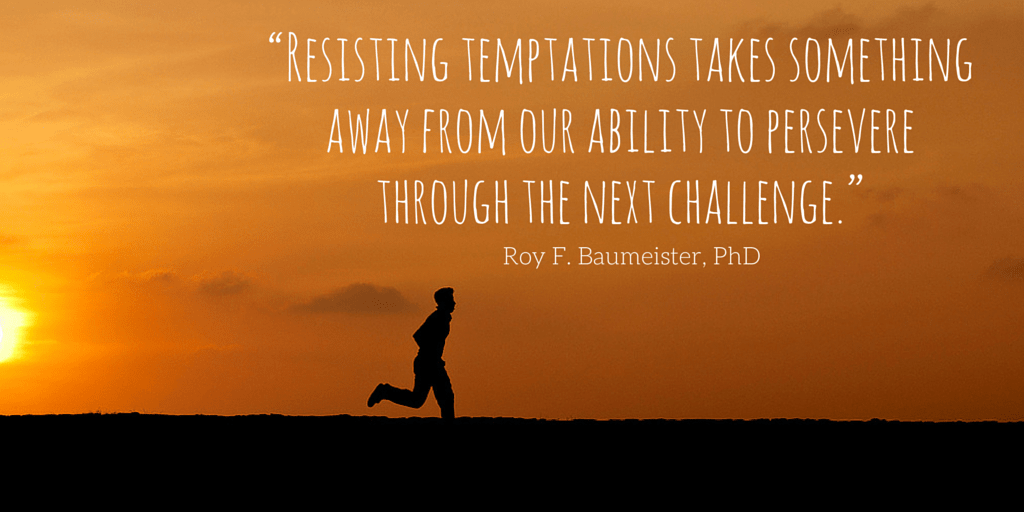
What he had to say snapped into even sharper focus when he added that “Resisting temptations takes something away from our ability to persevere through the next challenge.”

TeachingSelf-Control (3)

Think about the factors that can impact a student’s ability to demonstrate self-control. We often think that self-control is a trait when reality is that it is a skill to be developed over time.

But that’s not how we always think.

We think some kids can behave and some kids can’t. Or maybe we think that some kids can behave and others just persistently choose not to (usually just to drive us crazy, right?).

I’m convinced that Baumeister is right. Self-control is like a muscle, and the more we test it, the closer it gets to failure.

So, what do we do?

I don’t have an answer for every student in every situation (and neither does anyone at the conference I’m at–which is both frustrating and reassuring all at once), but I’m wrestling with how to teach that to students. I really like the two new ideas that Baumeister provided. I’d like to share them here and see what we can think of about how these ideas apply to our efforts to teach self-control to our students.

TWO RESOURCES FROM BAUMEISTER

First, he mentioned an article from the Wall Street Journal article  about Odell Beckham Jr.’s decision to not only keep from wearing out his dominant right hand, but also grow strength in that left hand by completing everyday tasks with it. “The Secret Left-Handed Life of Odell Beckham” (link) is a great example of someone who is wanting greater control of a part of himself. It’s worth noting that he is as good a receiver as the NFL has right now, so it’s not like he’s doing this because he can’t keep up on his own. He’s wanting to get better, and I can’t wait to find ways to package this for student viewing.

Part of me wishes he had a list of things we could to to help our students “use the other hand” to develop more resilience, but I think I’m happy the question is still out there. I’m still mulling this over myself, and I’m benefiting from the thought process.

Baumeister’s other example that really stuck with me centers around this image:

sirens

Here, Odysseus (or Zeus) is subjecting himself to temptation. Sure, he’s putting some constraints in place to help him keep controlled (tying himself to the mast of the ship), but there’s a better way. In Baumeister’s words, “Those with self control don’t do what Odysseus did here; they take a different way home.”

I love the image and how plain it makes the risks of the temptations that come at us.

SELF-CONTROL AND OUR STUDENTS

The more I think about it, the more I think I’m convinced by Roy Baumeister’s compelling comment that there are similarities between working out a physical muscle and working out our self-control. That part is easy to nod along with, but the implications are significant.

Every coach knows that athletes will be pushed and will sometimes fail. Is that how we treat students who are being stretched in their ability to demonstrate self-control?

Rarely.

But that’s the task at hand. Teenagers experience a surge in brain plasticity during adolescence, and it’s our job to make sure we are helping stretch, grow, and cultivate students’ ability to demonstrate greater and greater self-control.

LET”S WORK TOGETHER

Let’s collaborate on this. How will you begin to put this into practice? What ways can you think of that help students to “use the other hand” or avoid the sirens on campus? I have a few ideas, but I’d love to hear what you think.

Leave a comment with an idea or some inspiration for others who are working to help teach self-control.

3 Ways To Embrace Vulnerability

3 Ways To Embrace Vulnerability (1)There’s a lot of buzz in education right now about vulnerability. Many are talking about how it impacts leaders and their ability to connect with others, and more are talking about the trust that’s required for school wide risk taking to become a reality.

If you ask me, we’re starting the right conversations.

One of my favorite lines that I’ve come across as I’ve navigated the vulnerability/risk taking conversation is by Brené Brown. From her perspective (and more and more, I’m becoming a believer and adopting this mindset as well), “Vulnerability is not weakness, rather it is our most accurate measurement of courage and the birthplace of innovation, creativity, and change.”

Hers is a pretty bold claim. Think about what’s really at stake in that line. She’s saying that three of those things that seem non-negotiable for student success–innovation, creativity, and change–they’re an impossibility without embracing vulnerability.

So, it’s good that we’re talking about it.

My worry is that when it comes to vulnerability, we’re getting better at talking about it than at actually living it out. It’s certainly easier to talk a good vulnerability game than it is to live (or start) a life lived vulnerably.

With that in mind, here are three ways we can embrace vulnerability, not just as an idea, but as a week-in, week-out practice at school.

ASK FOR CRITICISM

We all like to think we are open, available, and easy to talk to. More often than not, though, I’m betting we give ourselves more benefit of the doubt here than we should.

Inviting some criticism shows that we really believe that getting better involves having hard conversations, and asking others on campus for their feedback in those moments values the feedback and perspective of the others with whom we often interact.

Asking for feedback without giving any parameters is likely to yield either overly general feedback or overly specific feedback. Give people a couple of choices or maybe even give them a template to work with to help direct their feedback. That also helps ease toward the deep end of vulnerability without having to open up areas of ourselves where we’re less than comfortable venturing in those first conversations.

TRY SOMETHING NEW

Putting your money where your mouth is by taking on something new–especially something that’s a challenge, that might not work–lets you really indicate that it’s okay for others to tackle that idea that maybe only has a 50/50 shot of working.

A lot of educators probably bury ideas because they’re not sure how to work through something that might fail. Your work can serve as a great model (one that you don’t have to nail down the first time; it can be a work in progress, too) for others who are looking for someone who’s willing to take on a new idea, work through the mess, and come out better for it on the other side.

OWN YOUR MISTAKES

Mistakes are inevitable. We have to be willing to own them and use them as the point of departure for productive growth in ourselves. That’s an idea that’s easy to nod your head along to, but it’s tougher to live that out.

In those time where we make tough decisions that impact others and things don’t turn out, I think it’s important for others to hear us and see us take responsibility. That’s not a popular narrative for most. Strength is all about covering up mistakes and appearing flawless and faultless for many. If we really want to bring people together and foster the kind of campus culture that brings people together rather than pushing people apart, then we have to be willing to have take this sort of action at every level of leadership on campus.

Because It’s Worth It…

Not only is there far too much on the line for us to blink past the necessity of living vulnerable lives in our schools, but there is also so much up side in taking on even just one of these challenges. Neglecting to pursue this is a recipe for stagnation and regression.

It’s not easy. It won’t always be much fun. But the work to open yourself to others, regardless of your role on campus, makes you a leader.

Two Important Phrases

Two Important PhrasesMy oldest, Graham, is four (and he’s awesome) and over the past few weeks, he’s said two things to me that I think aren’t just what four year olds need to hear; they’re what all people need to hear.

Here’s how it played out:

In general, Graham is a pretty good listener. He knows where the boundaries are and generally follows our set expectations. Even on the best of his days, there’s always the wild card at the end of the day–the time that could just go any number of ways–bed time. It’s easily of the toughest times for Graham to keep it together. We have a decent bedtime routine, and he knows the expectations for him once we’ve tucked him in, but it’s still tough. Each night, after we review his bedtime expectations, he’ll repeat them back to me

“Look at the stars (his nightlight), be quiet, be still, no getting out of bed.”

Everything but the last line (which was his addition to the list–one that get’s no arguments from me) is phrased positively and clearly reviewed, but he just can’t bring himself to consistently stay in bed when it’s time.

After a few days of unsuccessful attempts to get him to sleep quickly, he just nailed it. One of those things where you forget that you were worrying about it because he’s just taken care of business and nearly drifted off to sleep.

So, I peek in his room, inadvertently startle the little guy, and he’s looking right at me–half asleep, half awake–and I lean in and tell him that I’m proud of him for choosing to go to sleep so quickly. He smiles, asks for a hug, and as I’m leaving the room, he whispers for me to come back to tell him something. As I lean over to him, he says, “Can you tell mom what you said to me?”

Confused, I stumble through a few questions to figure out what he means until it dawns on me and I ask, “You want me to let mom know I told you that I was proud of you, don’t you?”

And with the biggest smile on his face he nods with exaggeration and hugs me as tight as his four year old arms will allow. It’s sweet to know that he sees that his dad is proud of him, and as much as that seems to fill him up, I think it does more for me than for him.

CRAFT (2)

Then there’s the other phrase.

A few nights later, Graham and I are circling around and around in conversation about something that ends up amounting to a “The adult gets to make the rule, not the four year old” situation, and I raised my voice as I conclude the conversation with some finality, again reviewing his bedtime expectations.

I’m really not one to get agitated. Ask my wife, ask the folks I work with–they’ll all tell you that I’m the last guy to raise my voice about anything. But here, I did.

Feeling a bit sheepish about it all, I went back in to check on him about ten minutes later, and he asks me to sit on the bed. When I do, he pulls on my arm to draw my head closer to his, and he whispers, “Dad, say you’re sorry.”

And, of course, I do.

And in the sweet way that a child knows, he reaches up, hugs me, and offers a four year old’s restoration.

CRAFT (1)

Not long after that, I begin to wonder how much good would be done if we made sure these phrases were said more often.

What if the 14 year olds in our school heard the same two phrases–I’m proud of you, I’m sorry–when the appropriate time came?

What if students could expect to see adults own mistakes and apologize, providing a glimpse of vulnerability that comes with growth through big and small challenges?

What if students knew that they would hear genuine praise from their teachers, more than what they receive in grades, so that they would know that there are people at school who are proud of what they’ve accomplished, proud of the risks they’ve taken, proud of the changes they’ve made or the character they’ve shown?

I can’t think of a thing that would be hurt by us giving this a try. As you move through the coming days, look for opportunities to speak into the lives of your students and situations where you may need to, in humility, embrace a misstep you may have made while serving others.

When We’re Not Enough

Untitled design (3)After writing this, it feels a bit odd to have not talked about any personal stories here. I can’t figure out a way to do that without violating FERPA or the trust of my students. If that weren’t enough reason, I still think my shortcomings in this area still might be too close to home to discuss here. Failure (perceived or real) is tough to tackle so publicly, so I’m speaking at a distance here.

I’m thankful for the book Jeff Hobbs wrote for many reasons, but one of them (super selfishly) is that it provides some context for me to talk through this struggle without breaking the law or the trust of others. Forgive me for speaking in generalities or for only referencing a learner I’ve never met. 


robert peaceIn his book, The Short and Tragic Life of Robert Peace, tells an unforgettable, Jeff Hobbs tells the true story of his college roommate, Robert Peace. Aptly titled, Peace’s story ends both tragically and all too soon. Here’s the summary from the back of advance copies of Hobbs’ book:
Robert Peace was born outside Newark, in a neighborhood known as “Illtown,” to an unwed mother who worked long hours in a kitchen. Peace’s intellectual brilliance and hard-won determination earned him a full scholarship to Yale University. At college, while majoring in molecular biophysics and biochemistry, he straddled the world of academia and the world of the street, never revealing his full self in either place. Upon graduation from Yale, he went home to teach at the Catholic high school he’d attended, slid into the drug trade, and was brutally murdered at age thirty.

For the longest time, I wrestled with that. How could his story end this way? Everything was in place, right? Robert Peace had what it we think it takes–determination, intelligence, no road blocks for a future, positive peer community at Yale, an so much more–but it wasn’t enough to keep his story from ending tragically. So many have overcome with so much less in their favor; how did he end like this?

That’s what I can’t shake.

That’s what I can’t understand.

That’s what leaves me frustrated.

Because when we put everything in place, it feels like the plan has to work. It should be enough. It should work. He should go on to do something, anything, that’s better than living a short and tragic life, right?

How do we respond when everything we offer isn’t enough or isn’t accepted?

For a while, it was really convenient for me to believe that everything we do–providing choices, developing meaningful relationships, and helping bridge gaps (socioeconomic, class based, race based, gender based, and more) just to name a few of the myriad of great efforts educators undertake in the service of students–was so compelling that students couldn’t resist it.

Many times, in practice, it would only take one extending one of these olive branches to create some change, and in tough situations, the right one-two combination always seemed to make the magic happen. You just had to get to know the student, prove you were in for the long haul, and meet the needs that were there (and the process seemed to work even smoother if you helped determine those through your own relationship with a student).

Please don’t get me wrong; I don’t mean to sound flippant about this at all. Serving students this way was what I love doing. I would go as far as to say I felt called to do this, designed to do this even. And I felt like in many cases, I even did this well.

But then there’s Robert Peace’s story. And everything isn’t perfect for him in his situation, but his story sure starts out looking like a movie script for the student who is going to overcome the odds. In fact, when you look at it, it really looks more like the script we would laugh at and say, “Things don’t come together that well, right? A full ride to college almost literally handed to you on a silver platter? Come on!”

But that’s his story. And the story still ends the same.

Moving forward

After finishing the book, I honestly felt a little hopeless and started questioning myself.

Had I done the right things for my students?

Did I do enough? What else could I have offered?

Did I forget something that could have made the difference?

Did I miss the mark because I didn’t know them well enough or provide enough feedback or attention in class?

Did my attention with some cost me precious time with the others?

For the longest time, I just didn’t answer the questions. I just left them out there. But earlier this week, I heard a presenter (Adam Saenz – Twitter link) say something along the lines of: Educators should feel okay to be worn out by their job. They should be okay with recognizing that at times, we have to pull back to recharge. And they should know that their work is tough and they don’t have to be superman and act like it’s not weighing on them. (If any of that sounds off, I’m sure the mistakes are mine.)

What he said brought me back to my questions, but with different eyes.

As an educator, your work is absolutely going to push you to your limits. Own that. You have limits–and the only way you’ve found them is by giving every last bit you had to offer to serve others. You can’t just keep giving without recharging yourself. Give yourself the space to admit exhaustion, invest in that which enriches you and fills you up, and continue your service when your cup is full.

Here’s what I wish I had done differently:

  1. I equated measurable, meaningful change with a particular response from students. I wish I had set a goal of relentlessly pursuing and pushing my students toward success. That’s what I could control–my end. I focused on a specific student reaction, not on my role.
  2. I reflected on where I could have done better, but I had no process for helping students work through the same conversation. As it turns out, I just beat myself up about “not being enough.” It wasn’t especially helpful for me, and it certainly didn’t do anything to help encourage students. They didn’t even know. I wish I had helped facilitate a conversation about getting better together.

I’d love it if I were the only person to go through this, but I suspect I’m not alone in wishing I could make more change happen than I was able to see through. I hope your work with students is fruitful, and I hope that in more cases than not, you get to see the fruits of your labor.

Educational Lifelines (aka Check Out These Blogs)

Throughout October, educators in our school district have been challenged to tweet once every weekday. We’ve had daily topics to help ease people in to that process, and things have been going well so far.

Today I woke up to this question:

CQynFhiWEAEWaZS

I just don’t feel I can do this question justice in only a tweet, so here I am writing a post about a few sites I can’t live without. (It’s worth noting that I can’t in any way provide anything close to a comprehensive answer in a blog post either, but at least I can do a little more justice to the question.)

While there are certainly a lot of well known websites out there that put out invaluable content for teachers, I’d like to highlight a few of the personal sites of educators here. I’ve learned so much from each of these educators over the past year. I’m intentionally going to leave you with a very brief summary of what you might find on each of their sites; take time to investigate their writing and engage in the conversations each of these folks are having.

Educational Blogs I Learn From Every Week

A.J. Juliani (blog, Twitter) writes a blog that will help you explore innovation and creativity in everyday situations you may come across as an educator.

Starr Sackstein (blog, Twitter) writes on a variety of topics. I’m most thankful for her example as a blogger, as this blog would not exist without this book she wrote on blogging and her blog that puts the ideas she shared in the book into action.

Pernille Ripp (blog, Twitter) writes with such passion for her work; it’s so easy to see she not only loves what she is doing, but she also wants to help others grow and has high expectations for the work that teachers do. Her work will push you and grow you as an educator. She also has another blog, Ms. Ripp Reads, that’s worth checking out if you’re ever needing to help students find something great to read.

Jon Harper (blog, Twitter) blogs about education and about his kids. His writing is a great reminder to me of the balance we have to keep between our professional and personal lives.

For me, both Jeff Zoul (blog, Twitter) and Jimmy Casas (blog, Twitter) serve as models of what effective leadership as a connected educator looks like in practice. Their writing is authentic, genuine, and challenging for me as a leader.

Kids Deserve It (blog, Twitter) is a fantastic blog that focuses on just what it sounds like–doing the things to serve our kids the way we should be. Todd Nesloney (Twitter) and Adam Welcome (Twitter) are a great combination of encouragement, challenges, and inspiration.

Leadupnow (blog, Twitter) brings together a group of growing education leaders who look at things differently. I’ve had the opportunity to write for them, and I enjoy the weekly pieces they publish.

Vicki Davis (blog, Twitter) writes with such contagious optimism and passion for her work and her students. She writes on a wide range of topics, and her blog is the perfect balance of pick me up and challenge for moving forward in the right direction.

I’m to the point now where if I get questions about anything regarding Google Apps for Education, I visit Alice Keeler‘s blog first for solutions (blog, Twitter). Her work is clear, concise, and incredibly helpful for educators trying to get the most out of GAFE.

So, there’s a few sites to keep you filled with great resources to read throughout the year. What do you like to read? Leave me a comment with what I should check out!

5 Ways To Spread Optimism in Times of Change

5 Ways To Spread Optimism in Times of Change (1)

This post originally appeared here as a guest post on A.J. Juliani’s blog.

In all likelihood, you know a few yabbits. They’re the people who can counter any great idea with “yeah, but…” before you’ve even finished presenting it. They don’t often like to change, or grow, or learn, and it’s hard to know how to respond to them at times. If you’re not careful, interactions with them can really rob you of your excitement for creativity and change in education.

Now I don’t think they’re in every school, but I’m comfortable claiming that they are in far more schools than they should be. As widespread as the yabbit seems to be, we need a plan.

I’d like to offer up 5 familiar “yeah, but…” phrases and explore a few hopeful suggestions for interacting with those colleagues who sometimes offer more negativity than you might like.

But here’s the thing about the plan: if we’re going to look at ways to turn folks around, we have to believe the best about them. We have to believe that people can change. It’s worth mentioning that that doesn’t mean we move forward naively. We certainly don’t need to assume that in 900 words I can turn around all the negativity on your campus or mine, but we do have to believe that with growth, we can do better (yes, we, even that teacher).

With that in mind, here are 5 common “yeah, but” phrases and a few hopeful ways to positively interact with those who choose negativity.

1) “Yeah, but we’ve always done it this way.”

You would be hard pressed to find a phrase that more clearly demonstrates fixed mindset in an educator that this. Although a lot of work has been done to clarify the ways that students benefit from growth mindset, when this rationale creeps up, it’s time for us to investigate how to develop a growth mindset in our staff. Here’s a great resource for ideas for doing just that. In addition, as an individual, think about ways you can help celebrate successes on your campus, especially when they result from trying something new that served students really well.

2) “Yeah, but I will have to work more.”

Unfortunately, the path of least resistance is well worn for some. This statement less likely to be communicated verbally and more likely to be seen in action. For that teacher who you notice continually puts in the bare minimum, think about asking him or her to collaborate on something that could benefit both of your students. Make sure you ask for help on something that you know that teacher feels capable at. Go out of your way to genuinely thank that person after the fact.

3) “Yeah, but it won’t work because of a problem with part X.”

Critical feedback, as long as it’s not negativity for negativity’s sake, can be a great filter for new ideas. This person is at least thinking critically about the ideas that have been presented at some point. Ask that person to help troubleshoot a new idea. If the person is any good at it, make that his or her job. If he or she is not, then coach that person up into a person who could make meaningful contributions to a team on campus. Making that person part of the team instead of a person who likely exists on the fringes could have a profound impact.

4) “Yeah, but I don’t benefit from that.”

The person who says this is at least thinking carefully enough to make this sort of assessment. Drive conversations back to the WHY that your school adopts. Maybe it’s a mission or vision statement. Maybe it’s a personal reason why you (or why the colleague) started teaching. Find an idea worth chasing and use it to re-center yourself and ask the colleague to join you.

5) “Yeah, but I don’t want to get better.”

Ok. They’re probably not actually going to say this out loud, but without using these words, they’re going to be saying this over and over. Try to start a conversation about what you’re learning. It might not even be something related to education at first. See if you can find common ground that relates to personal interests. Most people have something they enjoy that they like getting better at. That could be a place to start.

Here’s a quick check: Did you think “yeah, but…” as I asked you to think about adopting a new mindset for interacting with these comments from negative colleagues? If so, remember that. Even with the best intentions, it’s tough to change old habits. Doing so will take time and a combination of effort faith from you and the other person. While I hope that these ideas jumpstart conversations of hope for you, I know they’re not magic suggestions that make this effortless and immediately fruitful. For me, though, the growth over the long haul is worth it.

If you’re willing to take an active role in this process, you have the chance to redefine yourself at school and to help others redefine themselves as well. You have the power to be someone who positively and proactively interacts with others.

Before you move on to the rest of your day, think of one person who you can consider differently. Write down a name, and commit to growing yourself as you grow others.

The Right Stories

Let's talk about (5)

We like a good story.

No, not just me (which could very well be the case in some situations for this former English teacher). We all do. Stories drive us to do more, want more, and achieve more. They’re how we relax, how we inspire, and often, they’re how we find our place.

Sometimes, though, I worry we buy in to some stories that aren’t true as educators. They sound true, and if we’re not careful, we’ll use them as excuses or they can even become ways we beat ourselves up about our performance (or seeming lack thereof). Within each of them, I think there’s a kernel of truth, but when that warps into fiction, it has the power to bring guilt and shame onto us.

This semester, I’ve been reassured of this power held within stories; unfortunately, that reassurance has been brought to light as I’ve caught myself believing three particular stories about myself as an educator.

Like many educators this year, I’ve put plans in place that have failed, I’ve made missteps with students and teachers, and I’ve had to ask for help. Not all the time. Not even each week. But more than I’d like.

Like you’d assume, this has not been really fun for me.

I like to have things together for myself (because I’ve told myself I can help others better if I’m together–or if I can at least make it look like I’m together–I’ll leave that for another post though). But with each step, I’ve come closer to telling myself a story that’s true. One that’s a more accurate reflection of where I’m growing and where I need to grow.

I’m hopeful you’re able to recognize those places in you, and I’m hopeful that we can walk along the path toward growth together.

THE “I CAN MAKE EVERY STUDENT SUCCESSFUL” STORY

Investing in each student’s success is a great way to spend our time and effort. Even with good intentions, we could do far, far worse. Still, I think we sometimes fall into the trap of taking the blame when students choose to walk away from our best efforts.

Do I believe that great educators put every opportunity in place for students to be successful? Yes. Do I believe that great educators are invested in the relationships they maintain with their students? Yes. Do I believe that too often, educators take is too personally when students don’t take every opportunity that’s put in front of them? Yes.

I think you’d be hard pressed to find great educators who are satisfied with just helping most (but not all) of the students in their classes, but I do think that at times, educators begin to think that they can make every student be successful. This isn’t limited to academic success either.

THE “GOOD EDUCATORS MAKE THEIR STUDENTS BEHAVE” STORY

I also think that great educators inadvertently begin to believe that with the right experience, the educators who have this down (you know, those who have arrived, those who are pros at this) can make their students to behave.

Great educators certainly have more than a basic handle on classroom management. Their skills are extensive, they’re not easily rattled, they never escalate with students, and they can deescalate students with ease.

Still, their best laid plans can and do fail.

When they do, my worry is that others in the building start to look at a educator’s interactions with a student (nearly always a situation where the onlooker does not know what’s led up to that moment) and make a judgment on the educator based on the student’s behavior. I also worry that educators in this situation start to feel like a failure because he or she can’t make change happen as fast or to as great an extent as preferred.

I don’t believe that it’s the educator’s responsibility to make his or her students behave. You just can’t force them to if they’re bent on not doing it.

Here’s what I do believe: it’s a educator’s job to teach expectations for student behavior and reteach in response to gaps in student achievement. I see great educators putting innovative plans in place all the time to do everything they can do draw students toward the best choice. But even the best plans can’t make students comply (if they do force compliance, then while you feel you’ve won the short game, you’ve only demanded compliance; no transformation has happened). As much as we want it for our students, students have the great privilege and responsibility of stepping in the right direction with any given choice.

Still, at times, all of our tricks seem to fail, and we’re left wondering what to do now that we’ve tried everything.

THE “GREAT EDUCATORS DON’T NEED ANY HELP” STORY

When the plans we put in place don’t work, educators need to know when to call in extra support.

We tend to value those who are self sufficient and those who seem to not need the help of others. I don’t think this is unique to education, but somehow, despite what we know about the value of creativity and the help that is derived from connecting, collaborating, and interacting with others, the person who doesn’t seem to need any help often seems to be the one who is doing it right.

But teaching is messier than that. We need help to work through the toughest parts of the job (especially those that deal with the complexities of relationships). After all, we are pretty complicated.

I can’t think of a stage of an educator’s career where this gets easy. A new teacher wants to get in and prove he can do this job. A teacher with a few year’s experience wants to show he’s learned from the missteps of the past few years. Teachers with more experience might wonder how others would react to an experienced teacher who can’t handle a particular situation. And teachers who are already in coaching roles, no matter the level of formality involved, are the ones who are supposed to have figured this out, right?

Here, my worry is that in an effort to save face, we miss opportunities to serve each other and grow together as professionals.

The reality is that we don’t often love talking through mistakes and shortcomings, but we end up growing through that process in marked and impactful ways. Ways that tie directly to improving our work with students. Ways that make deep impact on the already fantastic work that educators are constantly invested in.

SO, HOW DO WE WRITE THE RIGHT STORY?

With so many potholes in the streets we’re traveling, I’d like to end with a few suggestions about how to make quick changes to make sure you are telling yourself the right story.

First, I think we have to acknowledge that recognizing that we need growth is not a flashing red light that should alert others that something is wrong. Recognizing our weak spots should be part of our professional process of improvement, but that’s easier said than done.

I’ve seen teachers use a “favorite no” or a “favorite mistake” as a point of departure for helping students overcome common mistakes. (Here’s a great video on the topic.) I wonder what the impact would be if we had a teacher version of this practice. What questions would it open up? What common ground would people establish? What solutions could come from those collaborative conversations?

I think finding unity in those things that we collectively need growth in could make a huge impact on developing a culture where risks are embraced and where a community of professionals can try on new ideas in a safe environment.

Where risk is welcomed and vulnerability is embraces, the right story writes itself.


One quick caveat: I’ve presented this as an antidote of sorts for the educators who work hard to serve students well but might still be overly critical of themselves or others. The concessions I’m offering in response to the worries mentioned here are not at all licence to do things half way or give up before doing your very best for the students you serve.

Set Students Up For Failure?

I’m fascinated by our opportunity to teach our students about failure, its impact, and their ability to overcome their own failures. I know I would have benefited from this instruction as a high school student, so it’s often on my mind as I work through each week on campus.

I’m always looking for something that can help facilitate that conversation about failure well, and it was in pursuit of some new inspiration that I stumbled up on this video recently by a few graduate students at Harvard. I was fascinated by it. It’s pushed me to reconsider a number of assumptions I made (or wonder if I made), and in the best way possible, it’s left me with a few ideas I can’t shake.

There’s a lot there in this video, but more than anything, I’m stuck replaying this line from professor Heather Hill. When talking about the role that risk and failure play in our learning, she comments that, “Teachers who are crafty start to design instruction that kind of responds to that [the impending stumble] ahead of time and highlights it and brings it up, so that kids will make that mistake; it’s called provoking the stumble.”

PROVOKING THE STUMBLE

That phrase, “provoking the stumble,” I love that.

But here’s where I’m stuck: how do we balance the idea of provoking stumbles with the idea of individualizing to help students be successful? Outside of a “you have to know your students” answer, how do we give guidance to those teachers who do know their students well and still struggle to answer this question well?

The way I see it, if we know that students benefit from overcoming challenges, we know that grit is developed in that zone of just right stretch, how can we not begin to invest ourselves in provoking stumbles for our students?

If we’re going to go down this road (and I do think we need to start down this road–or maybe start blazing a new trail in this direction), we have to be prepared with more than a shoot from the him response to parents who, understandably, will question why we are doing this. From one vantage point over a shortened time frame, we are setting students up for failure. But given a longer view, we’re preparing students to know that they can recuperate from failure and overcome adversity.

WE NEED TO FIRST BE LIMITED IN ORDER TO BECOME LIMITLESS

Part of overcoming our struggles (I won’t put all this on you, but I imagine some will identify with this) my struggles is a healthy, painful realization that I can’t do everything I would like. This isn’t an exclusively academic or professional realization by any means. I wish I could run like I could when I ran cross country in high school. I wish I could stay up (to write this blog, even) late at night without feeling it the next day (or two or three). The reality is that I have limits.

New ones seem to show up each day.

I came across Phil Hansen’s TED talk around the same time I say the “What Makes Good Teaching?” short, and I think Hansen is leading me toward my answer. You see, Hansen is an artist who (spoiler alert) can’t draw a straight line.

Given the choice to simply give up on being an artist, he chooses to overcome a considerable limitation and “Embrace the Shake” so that he can continue to develop his creativity and pursue his calling as an artist. That’s all I’ll summarize; take a few minutes to take in his message here:

WHAT NEXT?

I need your help. How do you balance this dichotomy: helping students experience success v. helping students learn to overcome failure? I’d love to hear examples of how you balance both well. The ways that you “set your students up for failure” (which, when done in this spirit, of course, is setting them up for long term success) will help me help teachers, and they will help me think through the parallels for professional development in our school and district.

Please do share. I truly appreciate any feedback you have. Together, we can come up with some great ways to challenge and support students through failure toward success!

Really Listen

Sometimes the bad things that happen in

Not long ago, this blog was blocked (by mistake) by a social media provider. Pretty insignificant, right? Well, yes, in one sense; I do have plenty of other ways of communicating and plenty of people who are content to listen to me face to face. Still it was no less frustrating for me, and I realized pretty quickly that it was really starting to get to me.

I could tell because pretty quickly I was firing off Tweets (I say it that way because I wasn’t thinking too much about what I was saying–and subsequently removed said Tweets in a moment of greater clarity). I talked to folks at WordPress and to the people who host my site, and everyone said everything was set up the right way.

Inexplicably, though, I had lost my voice (or at least the one I have found through this blog) and lost control of the outcome. File a ticket and we’ll get to you as soon as possible was the message. On the front end, I did what I was supposed to do, and it didn’t pan out as advertised. Frustrating.

During the month or so that I couldn’t share my blog (oh how trivial this seems and how petty I am for feeling sorry for myself at all during this time), the toughest thing was knowing that there was nothing I could do. I just sat and stewed thinking, I have something to say and no way to say it (I know–that’s not exactly 100% true, but that’s what I thought).

On most days, I feel like I’m in control of my life, but during this process, I just felt helpless.

There was nothing I could do. Literally, nothing. Zero courses of action that could be taken.

Happily, something good did come from this, though not without a little conviction on my end.

As I started to realize that my lack of control was at the root of my frustration, I began to see my situation in light of the larger range of situations people face when they lack control. A quick thought through the tough situations students work through at school left me sorry for feeling sorry for me and thoughtful about what those high school students must shoulder at such a young age.

As frustrating as my experience was, I just can’t imagine being a high school student (or younger) and being aware of my lack of control over things many assume are givens. What do I mean–givens?

Things like, “Will the lights be on when I get home?”

Things like, “Will we have food tonight?”

Things like, “My parents can help me with this homework, right?”

Things like, “Will it be safe at home tonight?”

Things like, “I wonder how I can get home from school?”

In hindsight, yes–losing my voice on this blog is insignificant. But in the middle of that loss, it felt very real (again, I realize the position I say that from, and it feels a little absurd still). But it stuck with me. It made an impact.

As a result, I’m trying to be more aware of students who may be without a voice.

Over the next week, I’m committed to finding students who need to be heard, who need to know that all of life isn’t as uncontrolled as pockets of their lives may currently be. I challenge you to do the same. Do your best to find a few students with whom you have not connected yet and listen, really listen, to what they say to you. Your attention matters more than you know.

Let’s work together to really hear people and help make sure all voices are heard.