Will You Climb With Me?

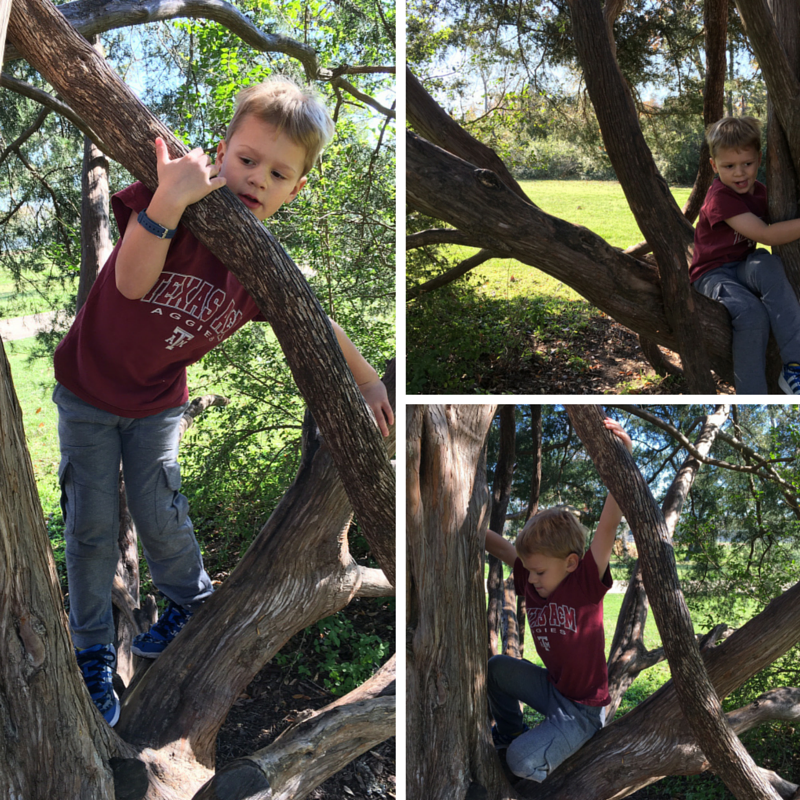
As soon as he left the ground, I saw the reaction on his face.

Equal parts excitement and fear.

Into the small tree he went. Climbing from branch to branch. Daring to move from the secure place he currently stood.

He turned to me and asked, “Dad, will you climb with me?”

But the tree wouldn’t hold us both. So I could be close by, but I couldn’t be right beside him.

It made me think of two experiences we have with students.

In the first, the thing that will help our students learn to take risks is our willingness to walk right beside them, risk in the same way they are. Maybe that’s writing in front of them, choosing practice problem you’ve not worked before so you can show students what working through the process looks like the first time, or doing experiments that truly ask new questions.

Submitting ourselves to the same risks we ask of our students situates us all as learners. That’s a small thing that ends up being a big deal.

But, as much as we can support them by learning alongside them, at some point, our students have to go out where we can’t protect them.

As Graham moved from branch to branch, I could tell he wanted me with him as much for the companionship as for the safety. But where he was wouldn’t support us both.

That scares me, but look at the fun that he had!

graham

Let’s get our students ready to explore past the reach of our safety nets and teach them to embrace new challenges with excitement.

A Post That Almost Wasn’t

It's A Struggle (1)

I almost didn’t post yesterday’s blog.

I wrote it, read it, thought it didn’t read clearly enough, and nearly deleted it.

But I’m glad I did.

I’m thankful for the folks who reached out and spoke truth to me.

“I get what you’re saying.”

“I’ve been there before.”

“Me, too.”

Honesty can be a little messy. It doesn’t always present cleanly. It doesn’t fit in the box. It doesn’t help that we’re trained to fight against that sort of vulnerability. Avoid the risk. Hide the feelings. Appear invulnerable.

So, if you’re sitting on a blog you’re unsure about sharing,

If you just hit post and are feeling a little exposed,

Or if you didn’t post and wish you had,

“Me, too.”

It’s A Struggle

It's A Struggle

I’ve spent about a year actually engaging on Twitter. It took me a while to come around to the idea that I could not only find time to engage, but also find that time was well spent.

In that time, I’ve learned more than I could imagine, connected to educators all over the country (no small task for this introvert), and begun to share on my own via Twitter (@aaron_hogan), this blog, and Voxer (aaron_hogan).

But with so many options for engaging online, it’s been pretty easy for me to walk a comfortable path for throughout much of that experience. Sure, there’s certainly a great deal of hesitation that accompanies the first time you jump into a chat or the moment when you finally, after great hesitation, hit publish on your blog. Those were big moments for me, but those risks dealt with the process, not the content of the conversation.

What I’m realizing is that one of the down sides of having so many great conversations to join is that you don’t have to have the hard conversations if you don’t want to. You don’t have to talk about the parts of education that are hard, or you have the opportunity to talk about them at a distance in terms of risks and vulnerability without tying those to a particular, personal issue. I think it’s time for me to start to dig into those topics a little more.

One example of what I’m talking about is the idea of the “I’m in classrooms for an extended part of my day” administrator.

I can’t remember an idea that I’ve been so drawn to yet so unable to realize in practice.

My failure to put this into practice, or even to put a first step into practice, really weighs on me, and I find myself struggling with a lot of different emotions when I hear principals talk about being able to be in classrooms so much.

I’m jealous of their time spent with students, the relationships developed there, and, honestly, of how easy it all looks on this side of a Tweet. At later points, that turns to hope for a future new normal for myself, but that can seem like it’s awfully far off in the distance at times.

I hate that this is my reaction. Really. I struggle with that.

I have a great deal of respect for what these educators are able to accomplish day in and day out. I’m awed by their impact on students and campus culture. I’m spurred on by their willingness to do the job differently than many educators, yet I find myself in this fearful pattern that takes some work to shake.

And so I start with something small (read that as “easy” so I can have a little success on the front end). Maybe I’ll try to add an hour, just a class period a few days this week. But when that, too, doesn’t pan out, the defeat that’s left feels pretty final. I just feel foolish that I can’t make it work.

It sounds so easy. If you want to not be in the office, just don’t be in the office, right?

Well, I can’t seem to make it work.

Admittedly, I don’t see as many assistant principal voices (or at least I don’t identify many as such) talking about being able to engage at this level with students; maybe this isn’t part of the job I’m doing now.

But I feel the weight of it, and I want to grow into this habit as a school leader. I don’t think I’m alone, but it doesn’t make it feel any less so at times.

Though I’d gladly take any pointers on getting out of the office, that’s really beside the point here. I guess I’m sharing this to say this: Living through the struggle, the emotions, and the effort to rise up out of that feeling that comes when you’ve tried and tried and continue to fail is worth it. I think it’s important we hear that not only from the people who have conquered the mountain, but also from those who are standing at the bottom looking for the path.

As you grow and work through failure, you’re not alone. I say that for you and as a reminder to myself.

You’re not alone, and it’s worth it.

Hawk Tackling (a disruptive innovation)

Embrace Challenges (4)

The Seattle Seahawks, though they are having a down year this season, are known throughout the NFL as having a impressive, innovative defense. Anytime someone is exceptionally good at something, it’s worth looking at what they’re doing to innovate and excel at such a high level. The Seahawks are no different.

The Seahawks have adopted what they term “Hawk Tackling” for their defensive players. Essentially, their players tackle differently than those on nearly every other team in that they don’t lead head first; instead, they tackle like rugby players do (who play their intense game with no head protection).

Other coaches are starting to notice how disruptively innovative Hawk Tackling is. Here’s a brief video (30 seconds) that’s worth watching to get a sense of what Hawk Tackling is all about.

(Click here to read the article this video came from.)

NFL players (much to the detriment of their health it seems research is now showing) have tackled the same way for years and years. Introducing Hawk Tackling is certainly a disruptive innovation on football fields across America.

After seeing this, I’m left wondering what practices we have in place that might need to be reevaluated.

What are we doing that could have long term negative impacts on our students? What do we need to reconsider? What are those sacred topics–the ones we can’t touch for whatever (usually not that great of a) reason?

It’s worth our time to crack those ideas open so that we can make sure they pass a check with our vision for the students with whom we interact.

Before you drill down to the campus/classroom level, leave me a comment about the areas you think we as educators need to rethink. I’d love to see your perspective, and I’m sure it will push my thinking. I have a couple of ideas myself, but I’ll share those in the comments soon.

Embrace Challenges

Growing up, I can remember my dad going to exactly one movie: Apollo 13.

As a Mechanical Engineer, how could he resist the pull of a movie where the engineers are the heroes of the day?

This is the scene he came home telling me about:

I love the way they approach this.

They’re faced with an impossible challenge and asked to be creative. Engineers who’ve precisely crafted aircraft for particular purposes with years of testing (to keep a mistake like this from happening), and they’re the ones tasked with developing a “creative” solution.

While it’s certainly impressive that they accomplish this feat–very square peg into very round hole–the way they go about out it leaves me with a lot to think about.

After the problem was defined, their first reaction was to say, “Let’s get it organized. Let’s build a filter. Gotta get some coffee going.”

I love that their first instinct was to be positive and proactive. There’s no complaining, no frustration, no negativity. Instead, in the space where those less than productive reactions could live, ingenuity and creativity win the day. Even though it seems insignificant, I like third line, too. They’ve got the coffee brewing, and after some of the most strenuous work of their lives, they’re ready to put in the necessary time to fix this problem within the timeline using none of the parts and pieces they would request if creating a design on their own.

The cast of characters is wonderful here. They’re clearly a team, and they put forth a wonderful product that’s a clear solution to the challenge at hand. But I don’t recognize any of them. And I like that. I really like that. I’ve seen the movie dozens of times, and these guys, though they get their moment here, they’re just a group who came together quickly, solved a problem, and saved people in the process. (OK, I’ll concede that they were probably brilliant NASA scientists among the most capable in the world, but they’re still the guys who weren’t the face of anything. They’re working in what seems to be a basement of some kind; not exactly glamorous.)

In our work as educators, the parallels here are clear. Regardless of the seemingly impossible nature of the challenge, we have to remember to respond to problems proactively, be invested for the long haul, and trust that teams of invested experts can make the impossible reality.

A Winter Blogging Habit

91 Days of Blogging (2)

Winter can be tough.

As the seasons change, our habits get upset. Things we could do, we can’t.

It’s dark outside, it’s wet outside, and it’s an unwelcome change in many respects. However, like most experiences with change, there has to be a way we can make the best of this situation.

Enter Mark French (@PrincipalFrench on Twitter), a member of the LeadUpChat tribe, and a fantastic educator with whom you must connect if you have not already done so.

Last week, Mark shared an insightful connection about how the Norwegians have to deliberately celebrate the winter for what it brings. Failure to do so would put them at risk of succumbing to the overwhelming changes that come with a winter at such a northern longitude.

He made the connection and shared this wonderful idea–blogging every day of the meteorological winter calendar. That means posting a blog every day from December 1st until February 29th.

This is not happening without a healthy mix of both trepidation and excitement. I’m excited to take on an idea that scares me, and I’m worried that I will publicly fail at the task at hand. The reality is that I will likely miss a day, and I need to be good with being fairer to myself about my limits.

I’m looking forward to the opportunity to try out a few new structures for my blog posts–things I wouldn’t try normally, but that I could grow into with a more regular blogging habit.

I’m anticipating the habit of white space that this will require of me. I need to take the time for myself to grow in order to be the husband, dad, assistant principal, and leader that I hope to be. This, rather publicly, allows me to call myself into action.

More than anything, I’m looking forward to daily finding the positive, life-giving, learning experiences and spending some intentional time focusing on reflection upon and sharing of those growth experiences.

I hope you’ll join me in the journey.


I’m not going to be tagging people regularly in these posts. Tagging people with whom I am connected in 91 consecutive days of posts seems like a great way to make people hate me. So, if you’re interested in seeing these posts regularly, find me on Twitter or subscribe via email (look for that under the “Don’t miss a post” heading on the column to the right).